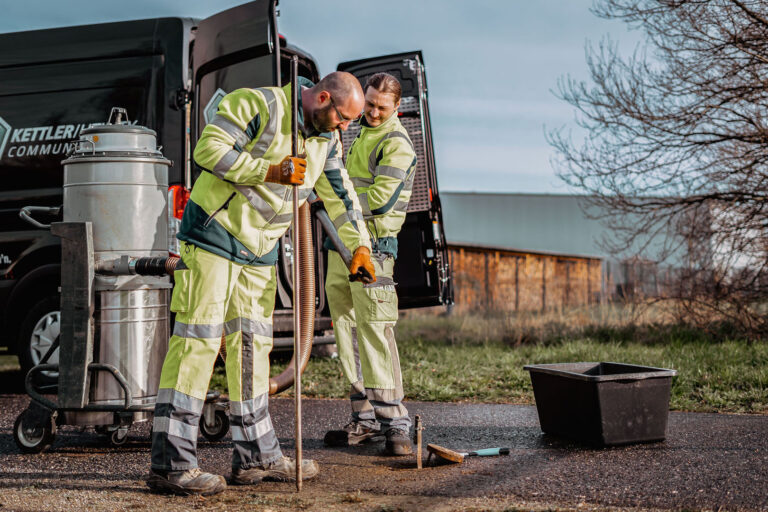
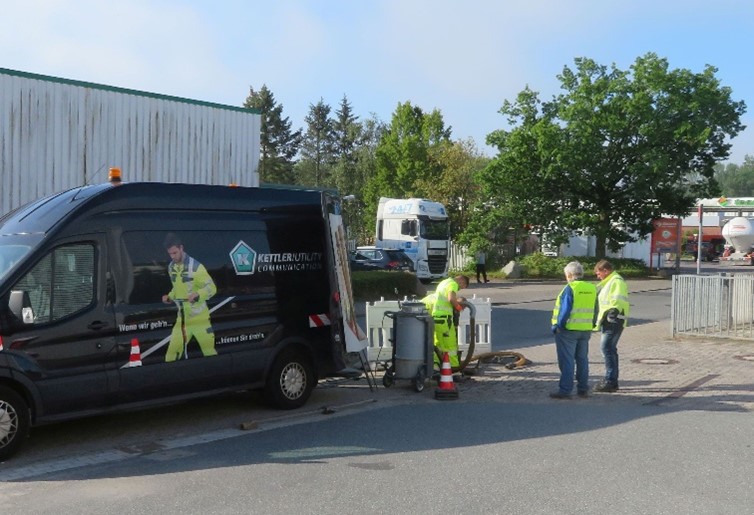
Rehabilitation of buried pipe systems in Schwentinental. A small suction dredger, a few special tools, some backfill material, and, on average, about two and a half hours: that’s all it takes to rehabilitate an underground utility connection using the innovative method developed by Kettler Utility Communication GmbH. In the town of Schwentinental (near Kiel), nine damaged utility connections were replaced in just 1 ½ days using this method.
By Boris Valdix
The telescoping valve assemblies, which were 20 to 49 years old, reliably operated the valves on drinking water lines. However, damage was recently discovered during routine valve inspections conducted by Stadtwerke Schwentinental. “The valve linkages were severely corroded due to road salt,” said Henning Jahn, network supervisor at Stadtwerke, describing the situation.
The original plan was to replace eleven valve assemblies. However, this was not possible for two of them, as they were so-called private main shut-off valves for which no standard replacement parts were available. “We decided to stop the work here because we couldn’t guarantee that these valves wouldn’t suffer significant damage. Furthermore, we were unable to source a suitable coupling nut for these very unusual valves,” explains Jahn.
A small hole is enough
As part of a pipeline flushing project, the city of Schwentinental was looking for valve turning machines and found what it needed at Kettler, with whom the municipality soon began discussing the trenchless rehabilitation method. This method allows for the replacement or maintenance of an underground valve assembly directly through the manhole cover. For about four years, Kettler Utility Communication has been offering in-place rehabilitation services nationwide.
Prior to the project, the client provides all information relevant to the construction site—particularly regarding the underground valves—using a survey form. In Schwentinental, the valves operated by the defective installation assemblies were located slightly more than one meter underground. Using a suction device and the Kettler method, the soil is first removed through the manhole cover, creating an annular space the width of the manhole cover down to the valve below.
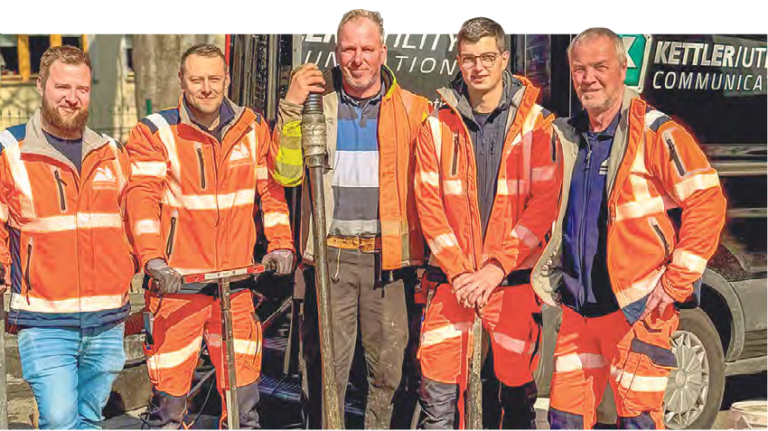
“Then we loosen the existing installation kit using a special tool and remove it. Next, we install a new dome-shaped sleeve and fit a new ‘KIT’ installation kit,” explains Patrick Rosenberger, Sales Manager at Kettler, describing the simple steps. The annular space is then filled with liquid soil. Rosenberger: “This has the advantage of sealing the annulus into a homogeneous surface and restoring 100 percent load-bearing capacity.” No special training is required to apply the Kettler method. Nevertheless, as certified pipeline inspectors, Kettler’s installers know exactly what they’re doing, assures Patrick Rosenberger.
Minimal effort saves time
“Kettler’s method is extremely fast,” says network manager Henning Jahn enthusiastically. “Before, rehabilitating pipe assemblies was only possible with a great deal of effort.” With the trenchless method, however, large-scale road closures are unnecessary, and traffic is not—or hardly—disrupted. Construction vehicles are unnecessary, as there is no need for excavation or surface restoration. Furthermore, gas and drinking water supplies do not need to be shut off. According to Kettler, rehabilitating a utility line assembly takes about two and a half hours on average. Key factors include soil conditions, installation depth, the size of the manhole cover, and any obstacles that need to be removed or bypassed. In Schwentinental, some large stones had to be broken up and removed; in addition, intersecting power cables demanded the workers’ brief but full attention. In some cases, buried plastic pipes installed to protect the valve assemblies also had to be removed. However, the fine-grained sandy soil in particular allowed for a relatively swift replacement of the valve assemblies, taking less than two hours per valve. Ultimately, Kettler needed only 45 to 90 minutes per valve assembly and completed all nine in 1 ½ days (the average is 3–4 valve assemblies per day). The original estimate was 2½ days. If the replacement had been done using open-cut construction, the entire process would have taken significantly longer. This method reaches its limits with valves with nominal diameters greater than DN 300. “In those cases, the connecting elements between the valve and the installation assembly usually become so large that they cannot be easily removed from the manhole cover,” says Rosenberger.
Great Potential
The new telescopic installation kits are now expected to provide reliable service to the city of Schwentinental for at least 20 years. “The Kettler Utility system is unbeatable in many respects. Not only does it feature a short dwell time at each valve and a small footprint, but its price-performance ratio and track record are also impressive,” enthuses Jahn. “In any case, we’d like to use the Kettler method again next year.” At that time, ten additional installation kits are expected to be rehabilitated using the trenchless method.
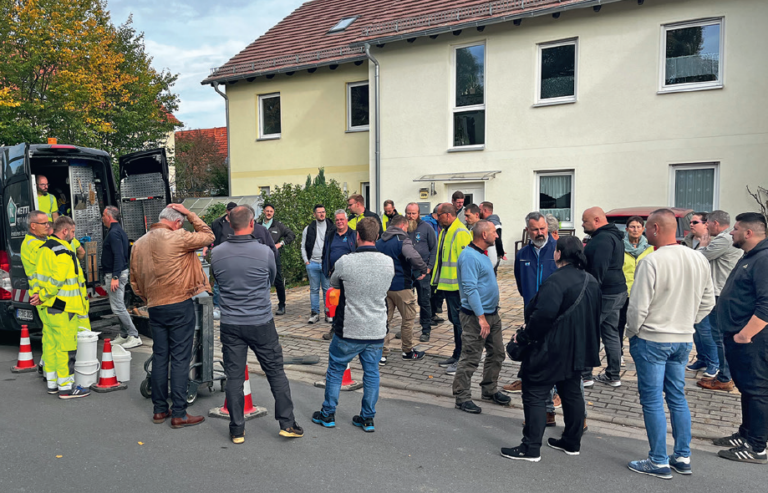
If things continue to go well for Kettler with this process, applications outside Germany are also likely. But for now, there’s still more than enough to do here in Germany. Patrick Rosenberger emphasizes that the process has enormous potential: “The market in this sector is huge. We have around 5,000 utilities nationwide and hundreds of thousands—or even millions—of fittings in the pipeline networks. Defective fittings are always a problem, and utilities are required to rehabilitate or replace about one to two percent of them each year.” That’s why Kettler took the opportunity during the project in Schwentinental to invite neighboring utilities, who were also able to see the process in action for themselves. And according to Rosenberger, they’ve already expressed interest in trying out the process.
Source BI_Umweltbau, Issue 5/2019 (pp. 50–52)